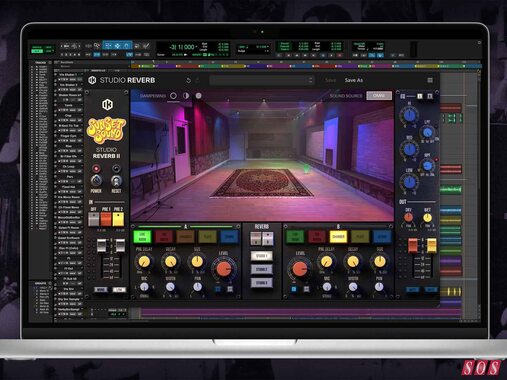
Sunset Sound Studio Reverb II is a new standalone and significantly expanded version of IK Multimedia’s popular T-Racks plug-in.

Sunset Sound Studio Reverb II is a new standalone and significantly expanded version of IK Multimedia’s popular T-Racks plug-in.

La Double Dragon est une pédale d’octaver analogique. Elle utilise la même technologie analogique que les grands classiques du genre. .. Lire la suite sur Audiofanzine

La pédale de fuzz d’inspiration vintage de SolidGoldFX est de retour dans une édition limitée aux couleurs de la Ford GT40… Lire la suite sur Audiofanzine

Présenté pendant le NAMM sur le stand Boutique Amps Distribution, le Royalist Preamp débarque chez les revendeurs… Lire la suite sur Audiofanzine

La marque regroupe six de ses banques de sons de pianos électriques au sein d’une collection complète… Lire la suite sur Audiofanzine

L’éditeur de banques de sons a enregistré le piano personnel de Marcus Warner, un Blüthner Style VII de 1907 restauré en 2021… Lire la suite sur Audiofanzine
Fanan team has updated Closseum mini modular DAW to version 1.2 and announced 50% discount on second and subsequent purchases of the same pack.
Main changes:
IK Multimedia has announced the release of Sunset Sound Studio Reverb II, a major evolution of their acclaimed studio emulation.
Moving beyond its origins as a T-RackS module, Version II arrives as a standalone powerhouse, significantly expanding the spatial depth and processing flexibility of the legendary Sunset Strip recording environment.
The update leverages IK’s proprietary Volumetric Response Modeling (VRM) technology to capture the acoustic nuances of Studios 1, 2, and 3. Unlike static convolution, VRM maintains the interaction between source position and room response, delivering the specific tone and movement heard on decades of iconic records.
The centerpiece of Version II is the new Live Room Positioning System. Users can now place sound sources in up to 27 distinct locations per studio. Because each position was captured as a unique acoustic event rather than being mathematically interpolated, the early reflections and boundary reinforcements remain authentic to the physical space.
Additionally, Studios 1 and 3 now feature modeled variable dampening, allowing users to adjust the studio’s physical absorption panels to reshape decay and tonal balance in real-time.
Sunset Sound Studio Reverb II introduces a dual independent reverb engine design. This allows for parallel routing of different spaces—for example, layering a Studio 1 Live Room with a vintage EMT plate or an AKG spring reverb. Each engine features its own EQ, stereo imaging, and routing controls.
The new Advanced Size Control goes beyond simple decay times. It dynamically scales impulse responses from 0% to 200% while preserving the original room’s tonal fingerprint. This enables engineers to shrink large rooms for tight percussion or expand small booths into cinematic environments without losing spatial coherence.
336 Stereo IRs: A massive expansion of the live room capture library.
Directional & Omni Modes: Choose how the source energizes the room (e.g., focused dispersion for vocals vs. uniform propagation for drums).
Modeled Analog Paths: Selectable preamp emulations of the API/DeMedio Sunset Sound Custom and the Class-A Discrete NEVE 8880 consoles.
Modern Interface: A redesigned 3D UI for intuitive source positioning and routing.
Standalone & Plug-in: Works as a dedicated application or within any DAW.
Loyalty Discount: Existing owners of the original T-RackS Sunset Sound Studio Reverb are eligible for a $/€50 discount automatically applied at checkout for a limited time.
The original Arturia KeyStep 37 has become a fixture in many a studio since it was originally launch in 2020. These days, it is almost impossible to watch a video on ‘Synth-tube’ without catching a glimpse of one, often surrounded by carefully curated pot plants, cacti, plastic figurines and other decorative memorabilia. It earned that spot by being a reliable, controller with hybrid capabilities allowing it to bridge not only hardware and software environments, but also MIDI and CV.
Sitting squarely between the streamlined 32-key base model we reviewed here at KVR, and the larger KeyStep Pro, the 37 mk2 iterates on the core design with quality-of-life upgrades and some new utility that make this version somewhat more desirable for folks looking for a controller to incorporate into live performances and hardware management, particularly CV enabled instruments.
For all intents and purposes, it is essentially the same keyboard as the Keystep, with a number of quality of life upgrades and expanded capabilities for hardware control. The build quality across the KeyStep line is solid and utilitarian. The chassis is plastic but rigid, built to survive the rigors of regular gigging and constant studio re-patching. Both units utilize Arturia’s Slimkey keyboard, featuring velocity and aftertouch. It’s similar to the Astrolab 37 which we also covered, and it remains excellent; the semi-weighted action provides enough physical resistance to avoid the « dinky » sensation common to mini-keys.
The most obvious differences are visible in the Keystep 37 Mk2’s size and appearance. You’ve got an additional 5 keys, two extra front panel buttons, a set of 4 endless rotary encoders and a string of LEDs, one for each key on the key bed.
The rotaries allow for control of MIDI CC parameters, up to 16 of them via 4 banks of 4. The knobs aren’t touch capacitive, so you have to turn a knob to see which bank you’re in at times, or alternatively click the MIDI CC button, but that automatically advances the bank selection. I did find this a little clunky at times. While the screen is clear and utilitarian, it is small, and I constantly found myself clicking past the bank I wanted to be in. That said, whilst useful, controlling MIDI parameters is the least exciting use for these knobs though.
Selecting control mode, the knobs will function contextually based on whatever mode you are currently in, be that overdub, mutate, sequence, arpeggiate etc. In sequencer mode they control Ratchet, Time Division, and Randomization. In arpeggiator mode they dictate Arpeggio Type, Time Division, Octave Range, and Arpeggio Length. In chord mode, they allow you to tweak the chord Type, Spread, Strumming, and Voicing. The most fun is mutate mode which allows far easier granular control of the mutate function, allowing you to quickly fine tune levels of Probability, Randomness, Polyphony, and Density.
While on the subject of the knobs, holding shift and selecting either CV Mod 1 or 2, will allow for control over the CV signals transmitted via the CV Control 1 & 2 outputs on the rear panel. On the Keystep MK2, you do this by accessing the settings menu. It’s far easier with the front panel controls… however Arturia didn’t stop there. They’ve added a new functionality for the CV Mod outputs, now including an ASR envelope generator, a cycling envelope (Rise, hold, Fall) and an LFO per output. The modes already available on the Keystep can have the voltage tweaked easily, the curves switched between linear, log and exponential all without the need to scroll through menus. This provides a ton of utility for modular users in addition to the sequencer functions of the Keystep 37.
Aside from the front panel controls, the most significant workflow improvement on the 37 mk2 is the addition of the individual, multi-coloured LEDs above the keybed. When integrating with hardware in particular, being aware of the sequencer’s exact state is huge boon.
It extends further to other features too. In Scale and chord mode, the LEDs indicate the root note being played, which notes belong to the selected scale or chord and which notes are being actively transposed or corrected.
When navigating the Sequencer, holding Shift displays your current Bank and Pattern selection in orange. During Arpeggiator playback, the LEDs provide immediate feedback on the current Arpeggio Octave and Mode.
This visual feedback removes the guesswork. On the Keystep, dialing in a sequence or overdubbing required relying heavily on the small OLED screen or simple memorization. The 37 mk2 maps that data directly onto the keys, making live pattern switching significantly less prone to error.
Lastly, since much of the sequencer and chord functionality is reliant on ‘shift + keyboard’ combinations, the additional 5 keys now provide extra shortcuts to switching scales between Off, Major, Minor, Blues and User scales.
The few gripes I had with the Keystep remain largely the same here for the Keystep 37. The capacitive touch strips for Pitch and Modulation are not my best. Placing your finger on the Mod Strip changes values from minimum to maximum, but unlike the Pitch Strip, it does not snap back to zero when released. It’s easy to accidentally brush the Mod Strip and inadvertently alter your patch.
Second, the heavy reliance on the Shift key. Modifying the « Spice » parameter (which randomizes Gate Length and Ratcheting) requires holding Shift and sliding the Modulation Strip. If you are playing the keyboard while doing this and fail to release the Shift button quickly enough, your subsequent key presses will likely trigger an unintended Arpeggiator Mode change.
The choice between the KeyStep 25 mk2 and the 37 mk2 comes down to application. If you need a minimalist controller to toss in a backpack for use with your laptop, the 25 remains the undisputed champion due to its ultra-flat profile and low cost. The creative and inspirational sequencer tools are added fun. I’ve taken the Keystep on two trips since first reviewing it and it’s convenient, robust and easy to travel with. The keyboard doesn’t feel rubbish like some budget controllers and it’s fun and satisfying to jam with.
If you are however driving a hardware rig, whether it’s desktop synths or a Eurorack system, the KeyStep 37 Mk2 is undoubtably the superior tool. Modular users in particular will get a lot of added utility here with the additional CV Mod modes. The addition of the four contextual encoders and the per-key LED feedback fundamentally speeds up the programming process and significantly reduces the stress of operating blind when using the sequencer. The Keystep 37 MK2 takes the success of the recently updated Keystep model and ’steps’ it up a notch with excellent visual feedback and additional hands on controls, making it a brilliant addition to a live or hardware set-up.
Pros
Cons
Platform generates 7 million AI tracks per day


